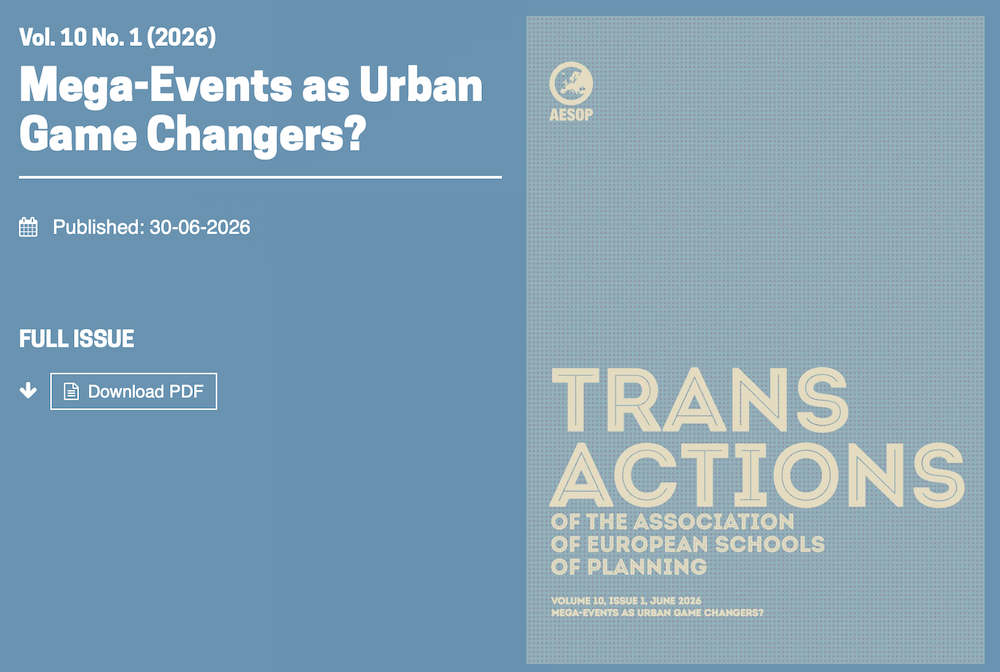

AESOP is pleased to announce the publication of Volume 10, Issue 1 (June 2026) of the Transactions of the Association of European Schools of Planning, the Association's international, peer-reviewed, open-access journal.
This new issue, entitled "Mega-Events as Urban Game Changers?", brings together a collection of original contributions exploring the complex relationships between mega-events, urban transformation and spatial planning. Building on discussions initiated during the 2024 AESOP Congress in Paris, the issue examines how major international events shape cities, governance systems, planning practices and long-term territorial development through a series of comparative international case studies.
The volume includes an introductory outlook by Marie Delaplace together with research articles addressing topics such as the urban legacy of the Olympic Games, the governance of large-scale urban projects, Olympic villages as catalysts for urban transformation, planning and sustainability under the Olympic Agenda 2020, and the relationship between planning systems and mega-events in cities including Paris, Athens, Milan-Cortina and Buenos Aires.
This issue also marks an important milestone for the journal, as it is the first published under the editorship of Professor Marco Cremaschi, following his appointment as Editor-in-Chief by the AESOP Council of Representatives in 2025. In his introductory note, outgoing Editor-in-Chief Olivier Sykes reflects on the journal's development since 2019 and reaffirms the mission of Transactions as an inclusive, open-access platform for high-quality international planning research.
As AESOP's flagship scholarly journal, Transactions continues to provide a freely accessible venue for innovative research across the full spectrum of planning theory and practice. All submissions undergo a rigorous double-blind peer-review process, reflecting the Association's ongoing commitment to academic excellence, openness and international collaboration.
AESOP warmly thanks the Editor-in-Chief, the Editorial Board, the Academic Board, reviewers and authors whose dedication and expertise have made this new issue possible.
We invite all members of the AESOP community and the wider planning audience to explore the latest issue and engage with its contributions.
Read the full issue here: