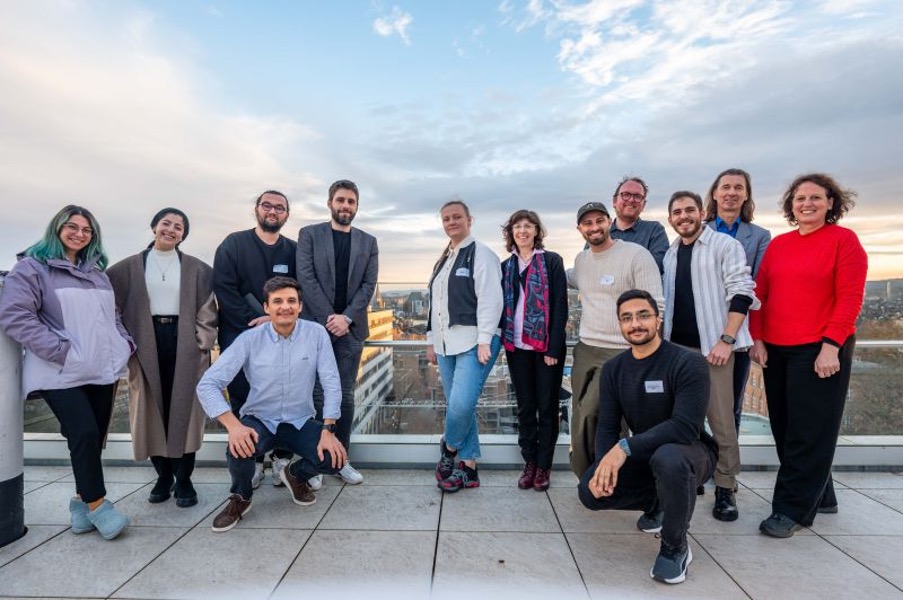
The workshop Planning Education in the Age of AI took place at RWTH Aachen University on 23 January 2026. The event was jointly organised by the AESOP Planning Education Thematic Group (Andrea Frank and Juliana Martins) and RWTH Aachen University (Fabio Bayro Kaiser).
The workshop featured thought-provoking presentations from practitioners, researchers and educators, alongside a dedicated space for in-depth discussion and collective reflection among participants. Drawing on contributions that explored AI use across practice, research, and education, the workshop contributed to ongoing debates on how planning education can engage with artificial intelligence both critically and effectively. In doing so, it highlighted the need to equip future planners with the skills to use AI thoughtfully, responsibly, and in ways that strengthen planning practice.
The programme included two keynote lectures:
- Rico Herzog(City Science Lab, HafenCity University Hamburg) opened the event with a presentation titled AI in practice: From algorithmic support to hyperreal planning?, exploring the growing role of AI in professional planning practice. (See the video here)
- Juliana Martins (Bartlett School of Planning, University College London) followed with Embracing, tolerating, or resisting AI? Reflections on the future of planning education, which addressed the strategic and pedagogical challenges AI poses for planning schools. (See the video here)
These keynote contributions were complemented by shorter “setting the stage” presentations, which helped frame the discussions by highlighting current experiences and challenges in planning education, practice and research:
- Tiernan FitzLarkin (Ulster University): “Planning education in the Age of AI – Challenges and Opportunities”. (See the video here)
- Marius Grootveld (RWTH Aachen University): “Culture Texture”. (See the video here)
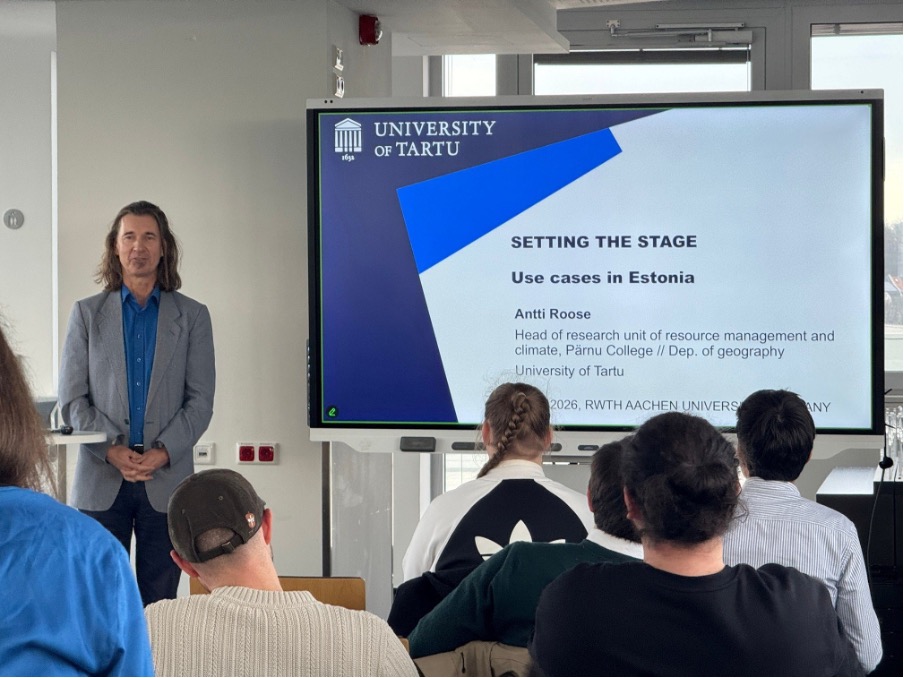
- Antti Roose (University of Tartu): “Setting the stage: Use cases in Estonia”. (See the video here)
- Caner Telli (RWTH Aachen University): “Live Data. Big Data. Smart Data? A brief excursion into live data planning and urban data platforms”. (See the video here)
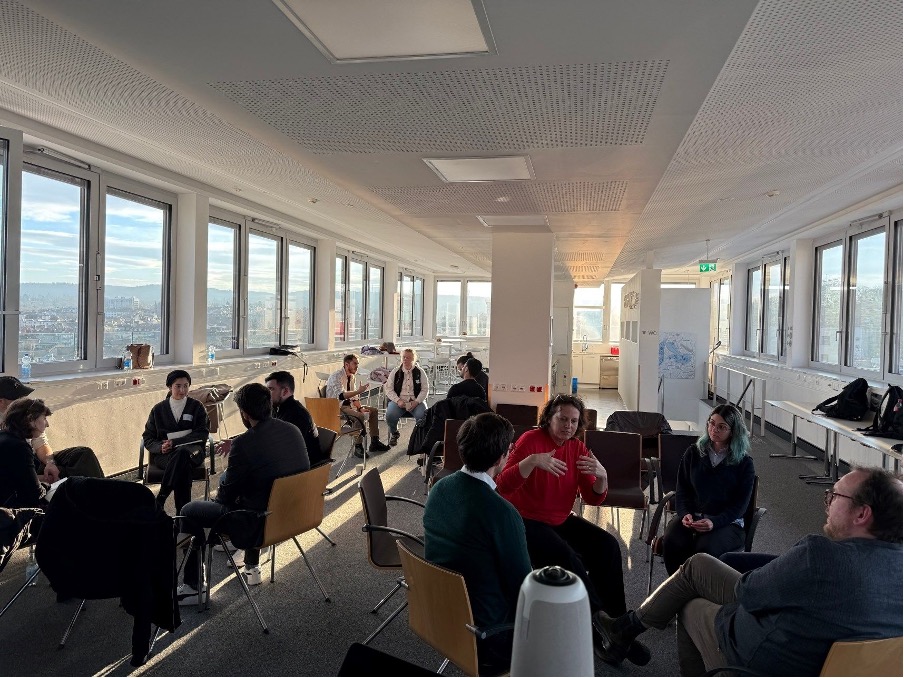
The interactive working sessions focused on two main themes:
- Challenges– Rethinking assessment: How can knowledge and skills be assessed fairly and meaningfully in a context where AI tools are widely accessible?
- Opportunities – Rethinking planning curricula with AI: How can AI support innovation in teaching and learning, and what new competences should planning education foster?
The workshop brought together around 20 attendees, enabling a focused and highly interactive exchange of ideas.
Key takeaways from participants:
Tiernan FitzLarkin:
- The approaches to AI in third-level education vary significantly, not only across countries and institutions, but also according to individual pedagogical perspectives.
- How we ultimately acknowledge or embed AI within planning education remains contested and is reflective of the ongoing debate within the wider sector.
- As planning becomes increasingly augmented, it remains critical to foreground specific dimensions (e.g., social, political, cultural) that distinguish planning professions from the existing AI technologies.
Antti Roose:
- There is a two‑tier and two‑mode pattern of adoption: on one hand, casual generative‑AI use in teaching, studies, and everyday academic management; on the other, specialised AI‑powered analytical and modelling tools. These operate in two modes - textual intelligence and visual intelligence.
- Both academic staff and students increasingly seek more systematic techniques, including structured prompt design and other methodological skills for using AI effectively.
- Critique of AI is shifting towards broader philosophical and ethical debates concerning teaching, learning and research. A clearer scoping (planning focus) of these issues is needed. Any ‘reality check’ should be grounded in recent practical cases within university courses and urban‑innovation projects where AI‑powered methods have already been tested.
Caner Telli notes that “AI must be understood and empowered as a tool, not as a savior or replacement. Those who rely on AI to think for them will find themselves obsolete when AI thinks without them”. He adds that:
- AI should be proactively integrated into planning education, particularly in analytical processes, to meet the growing volume and accessibility of data. However, for students to know what to prompt and how - which datasets are relevant, what results to expect, and how to apply them - they need a solid foundation in data analysis and data literacy. Therefore, it would make sense for me to begin planning education with manual, almost "primitive" mapping exercises in the early semesters, practising together how to read and interpret data. Once this understanding is established, AI can be introduced in later semesters to accelerate the process through well-crafted prompts.
- In concept development, I see significant potential in using AI as a sparring partner to test and refine ideas. However, students must be taught how AI systems actually work: they generate content based on probabilities and can produce erroneous or incoherent outputs. They do not „think"; they draw on existing training material and imitate it. Here too, providing the right prompts and curating the training material appropriately is essential.
- Crucially, planning remains rooted in people, so stakeholder engagement methods (interviews, surveys, participatory formats) should be taught as core skills. The insights gained from these processes are valuable parameters that, when properly evaluated, can be fed into AI systems (trained), supporting concept development and enabling a holistic perspective when sparring with one's own data and findings.