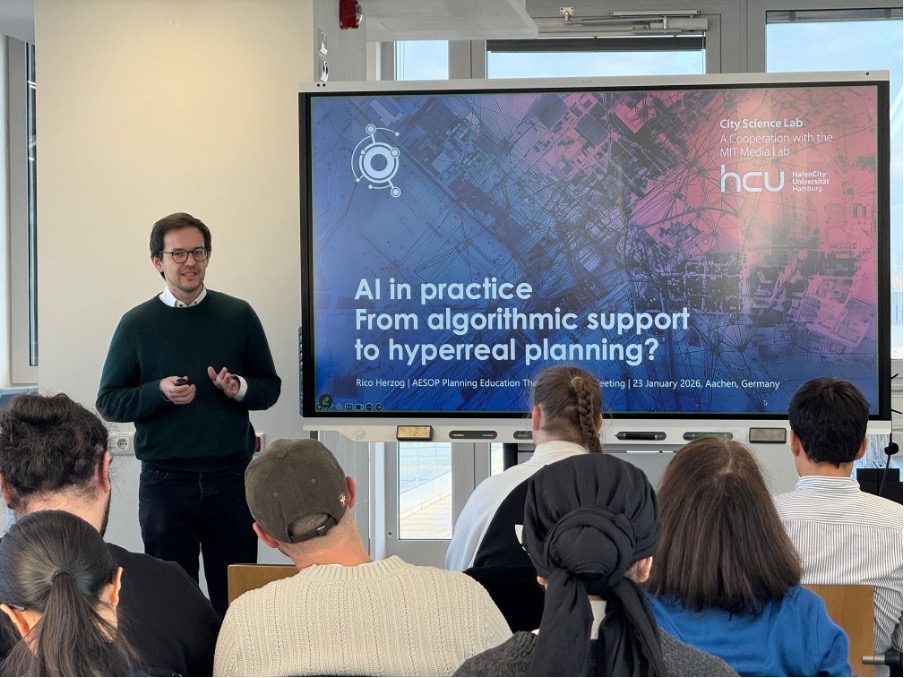
The workshop Planning Education in the Age of AI took place at RWTH Aachen University on 23 January 2026. The event was jointly organised by the AESOP Planning Education Thematic Group (Andrea Frank and Juliana Martins) and RWTH Aachen University (Fabio Bayro Kaiser).
The workshop contributed to emerging debates on how planning education can critically and effectively engage with artificial intelligence to better prepare future planners. It featured thought-provoking presentations from practitioners, researchers and educators, alongside dedicated space for in-depth discussion and collective reflection among participants.
The programme included two keynote lectures. Rico Herzog (City Science Lab, HafenCity University Hamburg) opened the event with a presentation titled AI in practice: From algorithmic support to hyperreal planning?, exploring the growing role of AI in professional planning practice.
Juliana Martins (Bartlett School of Planning, University College London) followed with Embracing, tolerating, or resisting AI? Reflections on the future of planning education, which addressed the strategic and pedagogical challenges AI poses for planning schools.
Keynote contributions were complemented by shorter “setting the stage” presentations by Tiernan FitzLarkin (Ulster University), Marius Grootveld (RWTH Aachen University), Antti Roose (University of Tartu), and Caner Telli (RWTH Aachen University), which helped frame the discussions by highlighting current experiences and challenges in planning education, practice, and research.
The interactive working sessions focused on two main themes:
- Challenges – Rethinking assessment: How can knowledge and skills be assessed fairly and meaningfully in a context where AI tools are widely accessible?
- Opportunities – Rethinking planning curricula with AI: How can AI support innovation in teaching and learning, and what new competences should planning education foster?
Keynotes attracted around 35 participants (in-person and online); while the interactive afternoon sessions had around 20 participants in person, enabling a focused and highly interactive exchange of ideas. Recordings of the presentations and further information on the workshop outcomes are available here.