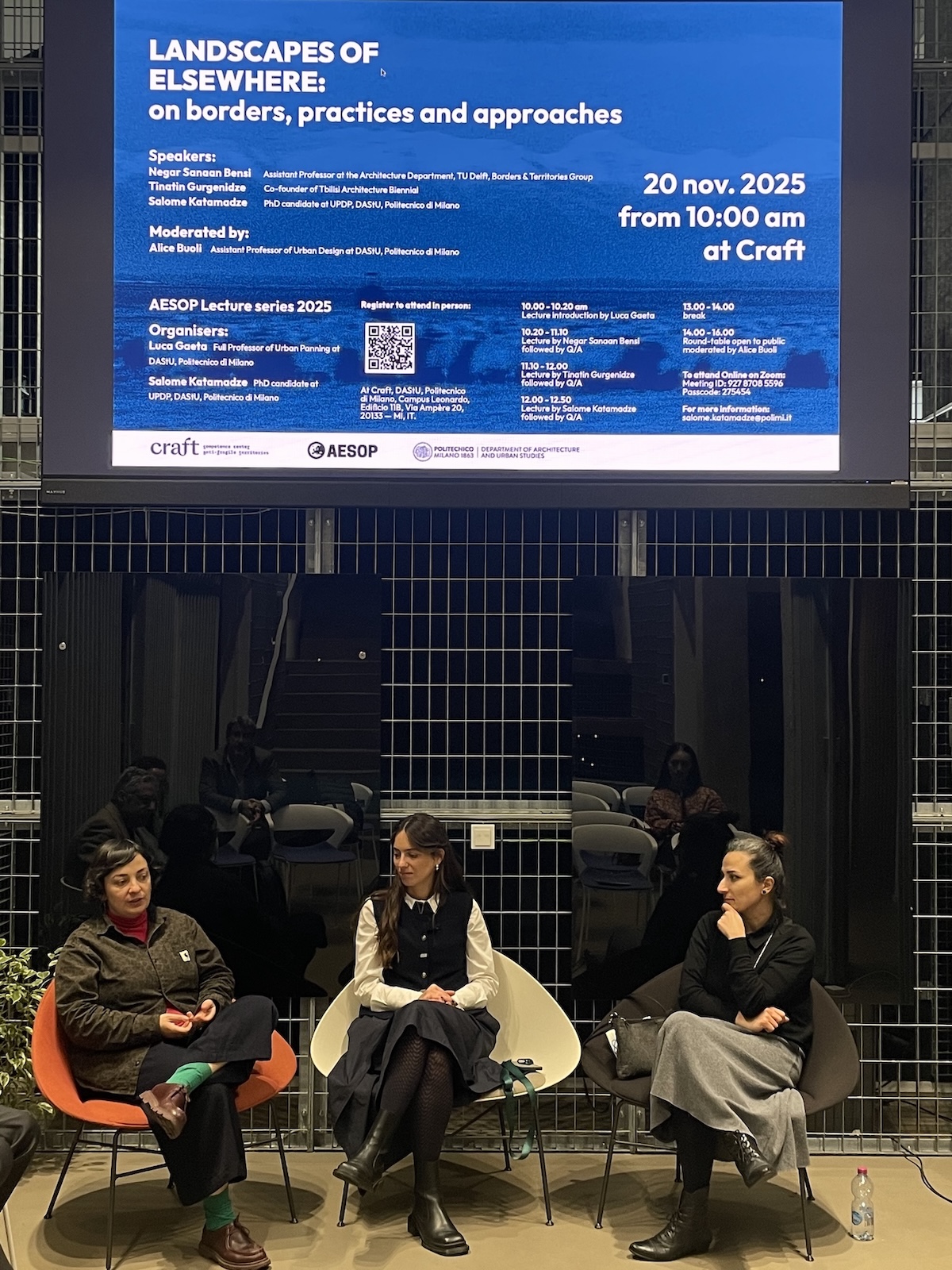
AESOP Lecture Series – Landscapes of Elsewhere: On Borders, Practices and Approaches
On 20 November 2025, the Department of Architecture and Urban Studies at Politecnico di Milano hosted the AESOP Lecture Landscapes of Elsewhere: On Borders, Practices and Approaches. The event, held in hybrid format at Craft (Campus Leonardo, Milan), brought together researchers working on territorial transformations in contested border regions. The session explored how landscapes themselves—through their materialities, ecologies, and long-term processes—participate in shaping borders and the institutions that govern them. The lecture was organised by Luca Gaeta, Salome Katamadze, and moderated by Alice Buoli (Politecnico di Milano).
Aims of the Lecture:
The session questioned prevailing narratives that frame borders as purely political constructs imposed on passive territories. Instead, it highlighted the reciprocal dynamic: if borders condition landscapes, landscapes in turn exert agency—altering, resisting, or reconfiguring bordering practices. The lecture interrogated the etymological and conceptual dichotomies underpinning contemporary understandings of borders and examined the non-human witnesses of crisis, conflict, and transformation in neglected environments. The lecture followed an invisible thread, starting the narrative from the borders of Iran, moving towards the Georgian-Armenian-Azerbaijan border, ultimately concluding on the Georgian-Russian border. This ephemeral trajectory helped follow the very different landscapes, however, facing certain similarities, in a way that accompanied the listeners through the geographies of elsewhere.
After the introduction by Professor Luca Gaeta, the three situated research contributions, the event provided reflections on borders that have been undergoing long-term environmental, political, and socio-cultural pressures.
Speakers and Contributions:
Negar Sanaan Bensi | Assistant Professor, Architecture Faculty, TU Delft – Chair of Borders & Territories
Research presented: On Thirst and Mirage: A Multilayered Spatial Mapping of the Dried Hamoun Wetlands in the Desert Border Landscape of Sistan
In collaboration with Mohammadreza Jarkeh, Sha Vaseghi, and Hamed Gholami.
An extensive research project on the dried Hamoun wetlands straddling the Iran–Afghanistan border. Drawing on mappings, archival materials, photography, and interviews, the investigation reveals the entanglement of water scarcity, displacement, technocratic interventions, and Indigenous knowledge systems in a border environment shaped by centuries of weathering and geopolitical contestation. The study shows how the movement of water —natural, manipulated, or vernacular—reconfigures landscapes, ecologies, and political relations, exposing the interconnections between culture, nature, power, and infrastructure.
Tinatin Gurgenidze | Urban researcher, curator, and co-founder of the Tbilisi Architecture Biennial
Research presented: Common Territories
The presentation shared insights from the multi-year project Researching Common Territories, which explores everyday shared spaces in the border regions of the South Caucasus. Through field schools, workshops, and cross-disciplinary collaborations, the project documents the lived realities of communities situated between Georgia, Armenia, and Azerbaijan. Its outputs—exhibitions, films, publications, and collective fieldwork—reflect how common practices, mobility, and informal interactions reshape the perception and materiality of borders. The contribution illuminated how cultural and social encounters persist despite geopolitical fragmentation and
how varied research methodologies, mostly found in artistic practices, can bring to the surface frictional narratives.
Salome Katamadze | PhD Candidate, Politecnico di Milano; Visiting PhD Researcher, TU Delft
Research presented: Across Border Landscapes: Mapping Traces and Narratives in the Caucasus
The lecture introduced her ongoing doctoral research on the transformation of the Georgian–Russian frontier over three decades of post-Soviet conflict. The project reconceptualises borders as dynamic and multilayered landscapes shaped not only by political imposition but also by local practices, ecological processes, and long-term socio-spatial transformations. By combining cartographic critiques, alternative mapping techniques, and the ancient practice of transhumance, the research offers new lenses for interpreting contested territories and the entanglement of movement, memory, and power.
Discussion:
The concluding debate, moderated by Alice Buoli, brought different contributions into dialogue around shared methodological challenges. Participants reflected on how to read environmental traces of conflict; how to build comparative vocabularies without flattening geopolitical specificity; and how design disciplines can visualise the often-invisible agencies of landscapes in border formation. The discussion further underscored the necessity of interdisciplinary, multi-scalar approaches to uncovering the political ecologies of borders and questioned the critical dimensions embedded in border-representation practices.
A significant part of the exchange centred on the practical and epistemic challenges of researching borders whose very nature restricts access—both to material evidence and to the territories on the other side. Speakers and attendees addressed the implications of these constraints for fieldwork, ethics, and positionality, as well as the methodological inventiveness required when working in contexts marked by surveillance, political tension, and limited mobility. The debate emphasised the need for adaptive, situated, and often improvised research practices that respond to conditions on the ground while remaining attentive to the partiality, vulnerability, and situatedness of knowledge produced in such environments.
Notes:
Due to the sensitivity of some of the materials presented during the lecture, selected parts of the speakers’ presentations have been removed from the publicly available video. The full, unedited version was accessible exclusively during the live online streaming and to those attending in person.
A warm thank you to everyone who participated and contributed to the event!
Venue: Craft, DAStU – Politecnico di Milano, Via Ampère 20, 20133 Milano
Date & Time: 20 November 2025, 10:00–16:00